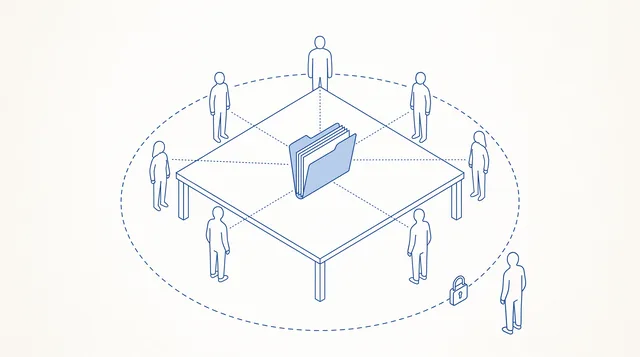
In short. A data room is a secure space where documents are shared with selected parties during a transaction or a proceeding, such as due diligence, with controlled access and activity tracking. Today it is almost always virtual: an online service where the owner of the documents decides who sees what, and when.
Data room meaning
For decades a data room was exactly that: a room at a law firm or an adviser's office, full of binders, where prospective buyers of a company came in by appointment, signed a register and took notes without being allowed to copy anything.
A virtual data room moves that room online. The rules stay the same: only invited people see the documents, each of them sees only what they need, and every access is recorded. What changes is time and cost: no travel, no copies, several buyers in parallel.
A data room is not an archive. An archive stores documents; a data room governs who reviews them, for how long and with which permissions.
How a virtual data room works
- Create the data room, often from a template with the folders a deal typically needs.
- Upload the documents into the folder index, including whole folders dragged from your computer or imported from Google Drive, SharePoint or Dropbox.
- Invite people with a role: who manages, who uploads, who reviews. Give each of them access only to the folders they need.
- Handle questions from buyers or the other side: answers go through an expert and an approval before they are published.
- Follow activity in the log: who opened which document, when, and what they downloaded.
- Close and export the data room with its log, and keep it available in view-only mode.
What a data room is used for
You need one whenever confidential documents must be reviewed by people outside the company and you may later have to show what was made available.
- M&A due diligence. The seller gathers contracts, financials, tax and corporate records; buyers and their advisers review them before making an offer.
- Fundraising. Startups share their plan, numbers, contracts and intellectual property with investors.
- Litigation and arbitration. Lawyers and experts share pleadings and evidence with the other side, experts and arbitrators.
- Tenders. Buyers make the tender documents available to several bidders, with the same information for all.
- Real estate. Property deals and portfolios with plans, valuations, leases and certificates.
- Escrow. Documents or source code stay locked until the conditions agreed by the parties are met.
Features that matter
| Feature | Why it matters |
|---|---|
| Access by role and folder | Each person sees only what they need, and you can revoke it at once. |
| Audit trail | The record of who viewed, downloaded or shared what, and when. It is the first thing you need if something is disputed. |
| Dynamic watermark and view only | They discourage copies and leaks. |
| Q&A with approval | Answers to buyers go out checked and stay on record. |
| Full-text search and AI | A clause turns up even across thousands of pages, with a link to the page that holds it. |
| Electronic signature | Agreements are signed where the documents are, with no extra steps. |
| Export at the end | Documents and log stay available after closing. |
Data room, file sharing and document management
| File sharing | Document management | Data room | |
|---|---|---|---|
| Used to | Move files | Organise everyday documents | Let third parties review confidential documents |
| Access | By link or folder | For internal teams | By role and folder, also for outsiders |
| Action log | Limited | Internal | Complete, exportable |
| When | Quick exchanges | Every day | Deals, disputes, tenders |
DocuMap brings the last two together: you manage documents every day, with AI, and open a data room when they need to go out. Explore document management.
How to choose a virtual data room
- Verifiable security: provider certifications such as ISO/IEC 27001, encryption in transit and at rest, servers in Europe if you work with European data.
- Fine-grained access control: roles, folders, access expiry, instant revocation.
- A log that holds up: ideally certified, so it carries weight with third parties too.
- Easy for guests: buyers and advisers should get in without installing anything or creating an account.
- AI on documents: answers that cite their source, and the assurance that documents do not train the models.
- Escrow and signature in the same place, if your deals have closing conditions or agreements to sign.
How much a virtual data room costs
Virtual data room pricing depends mainly on the number of users, the storage, the length of the project and the features included, such as AI, signature or escrow. Some providers charge per page or per gigabyte, others charge a monthly or yearly fee per room. Before you compare, estimate how many documents you will upload and for how many months you will need the room.
DocuMap does not publish a price list: the price depends on the deal and the features you need. Request a demo and we will prepare a proposal.
Frequently asked questions
What does data room mean?
A data room is, literally, the room where the data sits: the place, today almost always online, where the documents of a deal or a proceeding are made available to selected parties, with controlled access and a record of who saw what.
Is a data room the same as a virtual data room?
In substance, yes: a virtual data room, or VDR, is the online version of a data room. Physical data rooms, with binders in a room and visits by appointment, are now rare.
Who uses a data room?
Sellers and buyers in M&A, startups and investors in fundraising, law firms in litigation and arbitration, public bodies and companies in tenders, and software companies that place their code in escrow.
Is a virtual data room secure?
It depends on how it is built: encryption, access by folder, watermarks, an action log, where the servers are and the provider's certifications all count. In DocuMap documents and actions are also certified with a qualified electronic seal and a qualified timestamp.